
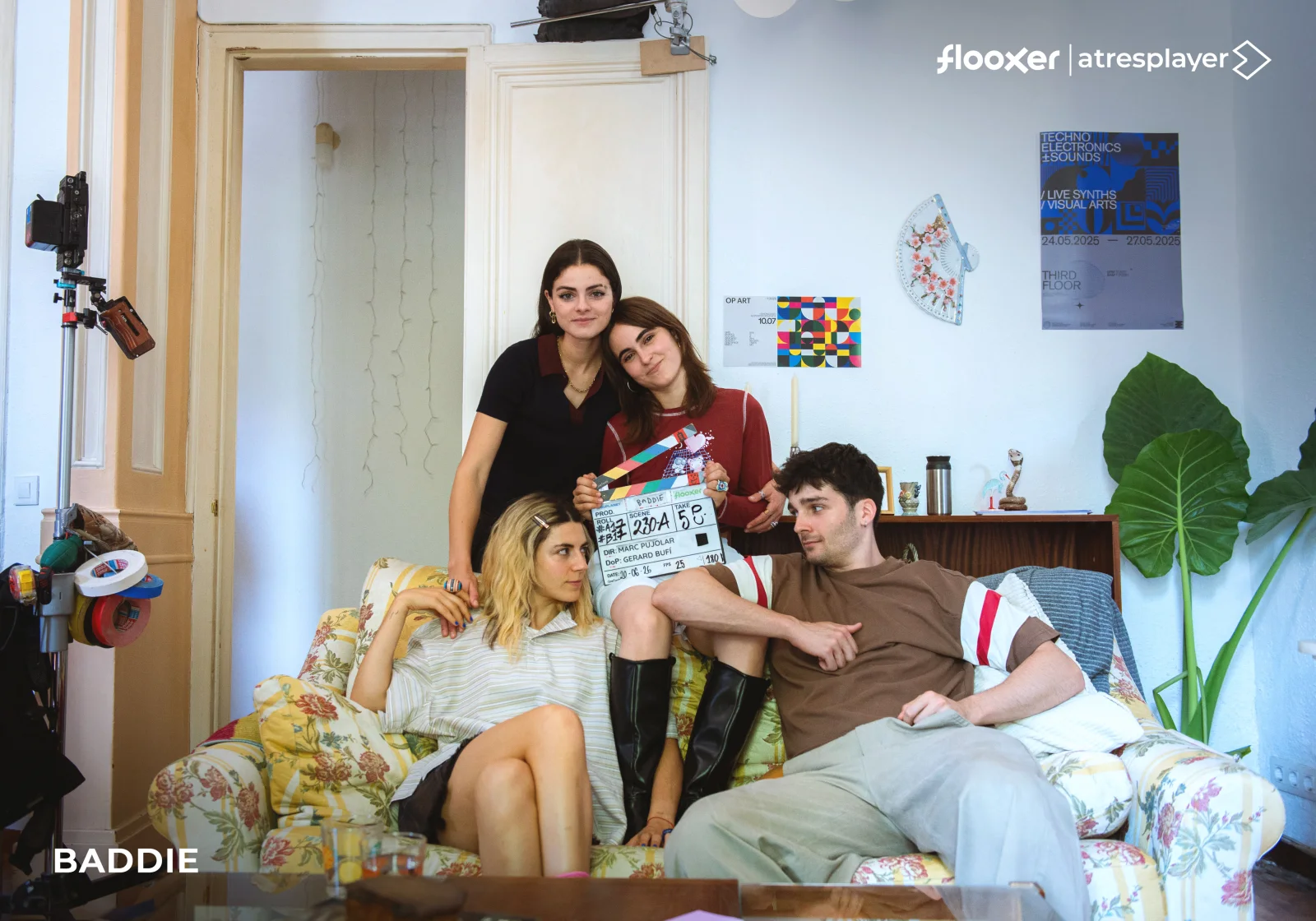
A vertical set still looks like a set
When director Marc Pujolar reached the Barcelona set, every camera and monitor had been rotated vertically. El País also reported roughly fifty crew, eight actors, two weeks of rehearsal and about five locations, including exteriors, for two seasons shot in two weeks.
Atresmedia describes Baddie as the first thriller in its vertical strategy for Flooxer and atresplayer. The production scale does not prove quality or demand, but it reveals which traditional elements the team believed a thriller still needed: spatial clarity, performance rhythm, serial clues and sound atmosphere.
Those two observations belong together. The work is mobile-native in format but sits inside the brands, production practice and membership relationship of an established audiovisual group. It is neither a few people improvising with phones nor a simple copy of Asian or American short-drama apps. It is a local experiment in combining a European crew, an existing platform and a new viewing habit, and its scale is evidence of chosen inputs—not evidence that the result or the business will succeed.
Two seasons in two weeks does not mean every phase was rushed
‘Two seasons in two weeks’ describes principal photography, not the whole production. Two weeks of rehearsal moved decisions upstream. Locations, blocking, continuity and vertical framing had to be prepared so predictable problems did not consume the most expensive time on set.
Short episodes make scene reuse, cast combinations, wardrobe continuity and hook placement central to scheduling. Compressed shoots also concentrate decision fatigue, so the team needs an explicit hierarchy: shots carrying story facts, shots carrying suspense, and shots that can be simplified without breaking the episode.
That hierarchy matters late in the day, when the final setups otherwise inherit every earlier delay. A schedule built only on script pages conceals how many narrative moments share a location while belonging to different episodes and emotional times. Scene reuse, cast pairings, wardrobe state, camera position and the episode ledger must agree. If they do not, hours saved on set return as continuity reconstruction in post-production.
Vertical is a redistribution of space, not a crop
Horizontal thrillers use edge space for threat. Vertical frames narrow that field, forcing suspense into depth, height, reflections, doorways, phone screens and sound. That is independent staging, not merely placing two actors closer together.
The narrower frame can favor faces, glances, stairwells and corridors, but excessive close-ups erase geography. Tests must happen on both production monitors and real phones, where captions, interface overlays, fingers, brightness and viewing distance alter the composition.
The phone test must also include the product that surrounds the image. Safe areas for buttons, titles and captions need room to change across services. Native vertical does not mean designing for an empty rectangle; it means understanding that the audience sees the drama through a platform interface. A technically clean monitor image can still lose a clue beneath subtitles or a thumb on the device where the story is actually consumed.
Atresplayer chose platform integration rather than a standalone app
Atresmedia did not build a standalone short-drama app. It placed vertical work inside Flooxer and atresplayer. That changes the problem from acquiring and monetizing a new app user to helping an existing member discover a format alongside long-form series and entertainment.
Public materials do not disclose budget, acquisition price, revenue share, viewing targets or title-level performance. The production proves organizational commitment and a platform experiment—not commercial validation. Evidence will come from release placement, completion, renewal, genre expansion and repeat commissioning.
Platform context can also change the writing. A standalone app may organize suspense around locks and paid episode release, while a subscription service may care more about whole-season completion, adjacent recommendations, brand fit and whether a character can return. Both need hooks, but not the same hook. A European pitch therefore has to explain where the title belongs in the existing schedule and member journey, not only demonstrate an arresting first three seconds.
European cost structures cannot be copied from China or the US
Labor rules, hours, insurance, locations, cast contracts, rights and post standards prevent a simple per-minute conversion from Chinese or US vertical production into Spain. There is no credible universal rate in the public evidence.
A more useful unit is the approved narrative unit, including writing, rehearsal, production, sound, color, captions, versions, rejected material and repair. A two-week shoot enabled by rehearsal and a fifty-person team moves cost upstream; it does not erase it. Local samples are more valuable than a global average.
Investors should ask which failure cost most, which roles expanded rather than disappeared in vertical production, and what each genre cannot afford to remove. Thriller, romance, comedy and action will produce different answers. Industrialization will depend on a Spanish cost-and-quality language grounded in approved scenes and repairs, not a currency conversion of somebody else's budget divided by minutes.
Performance and writing determine whether short episodes become stories
A thriller cannot survive on end-of-episode information alone. Each unit must balance remembered fact, present emotion and a question that changes what follows. Too much dialogue becomes broadcast; questions without facts feel mechanical; emotion without choice fails to build a relationship.
Phone viewing magnifies performance while fast editing can interrupt accumulation. Rehearsal helps actors preserve reactions and continuity across many short units. Speed and craft are compatible only when preparation carries the thinking the set no longer has time to do.
Eight actors and a rehearsal period do not prove the series achieves that balance, but they show that the production design treated performance continuity as work rather than as an automatic by-product of short duration. The relevant review question is whether an actor's look, breath or withheld response survives episode boundaries and changes the viewer's understanding, not how frequently a sting or cliffhanger appears.
Use Baddie as a method sample, not a success template
For producers considering Europe, Baddie offers questions rather than a template: standalone app, social service or subscription platform; native spatial logic; cast and rehearsal budget; adjacency to existing audiences; and rights for Spanish and further language versions.
The next evidence is repetition. Will Atresmedia commission more genres, retain teams, expose clearer discovery and share more creative or viewing information? One production attracts attention. Industrial capability appears only when later slates preserve craft, budget discipline and delivery.
A credible sales package should expose the method: a vertical sample, character and season architecture, episode rhythm, device tests, language plan, interface safe areas, separate caption and audio assets, rights scope, production calendar and quality gates. An integrated platform is assessing whether it can programme and extend a title, not merely whether one promotional clip performs on social media.
Europe's opportunity may come from refusing a perfect copy
Europe may not win by copying mature markets. Its assets include writers, actors, genre traditions, local languages, locations and existing subscriber relationships. Chasing only lower cost discards those assets; carrying every long-form practice into mobile loses the form's rhythm.
Baddie puts the tension on one set: every camera rotated, yet rehearsal, cast, locations and genre ambition remained; principal photography compressed, while the platform said it wanted consistent standards. It is a concrete sample, not a finished verdict. The work and audience must still prove the model.
If a distinct European position emerges, it may be neither cheaper television nor more expensive social video. It could be serialized mobile storytelling that reorders pace while using local craft and an established platform relationship. That proposition requires completed works and viewer behavior, not production rhetoric. Baddie gives the industry a specific case through which to ask the question; it does not answer it in advance.
Post-production decides whether compressed shooting pays off
Fast photography does not guarantee fast delivery. Many short episodes multiply titles, captions, audio transitions, hooks, thumbnails and metadata, while vertical close-ups expose continuity and repair. Editing, sound, color, captions and platform QC need explicit schedules.
A ledger should index both shot and episode. Shots carry source and repair; episodes carry order, hooks, captions, duration and platform versions. Only then can a team change one sound or subtitle safely and calculate the real cost of an approved minute.
Thrillers make the sound problem acute. Phone speakers, headphones and silent viewing are different environments; atmosphere, impact, distant sources and breath will not translate equally. The mix must preserve intelligibility without allowing captions to reveal suspense prematurely, and later languages alter dialogue length, lip relation, music rights and rhythm. A generic ‘two weeks for post’ line hides rather than schedules this work.
International versions begin at the script, not the dubbing stage
Spanish-language reach still requires territory-specific versions. Producers need separate dialogue, music, effects and ambience, plus scripts, names, terminology and emotion notes, so later dubbing is not locked into one final mix.
Vertical close-ups expose weak dubbing. Automated translation or lip tools still need human review of status, threat, pauses and irony. Distribution must also distinguish open publishing from curated acquisition; one Atresplayer production does not imply universal European access.
Spain, Latin America and US Spanish audiences do not share one release context, vocabulary, platform relationship or marketing assumption. A persuasive international master therefore combines native vertical craft with controlled dialogue and rights assets, while stating what the market has not yet proved. Every destination still needs its own check of territory, specifications, review, promotion, localization responsibility and monetization; a local commission is not a universal eligibility signal.
Release begins the most important production questions
Set reporting explains how a team worked; release evidence begins to explain how viewers watch. Starts, episode completion, continuation, season completion, return and exit need device and entry context. A high short-episode completion rate is not serial success if viewers never continue.
Creative review should return metrics to concrete decisions while ruling out captions, sound, product interruption and version changes. Without aligned methods, the industry should document status, episodes, dates, markets, entry and renewal rather than manufacture a cross-platform popularity ranking.
Metrics should prompt investigation, not dictate the next script. An exit spike may be a weak hook, a caption fault, a sound problem or an interruption in the product; a widely shared character clip does not validate the full arc. Editors, production and data staff need the same version and contextual sample before drawing a narrative conclusion. Transparent facts about releases and renewals will build a better European benchmark than an invented heat index assembled from incompatible platforms.