
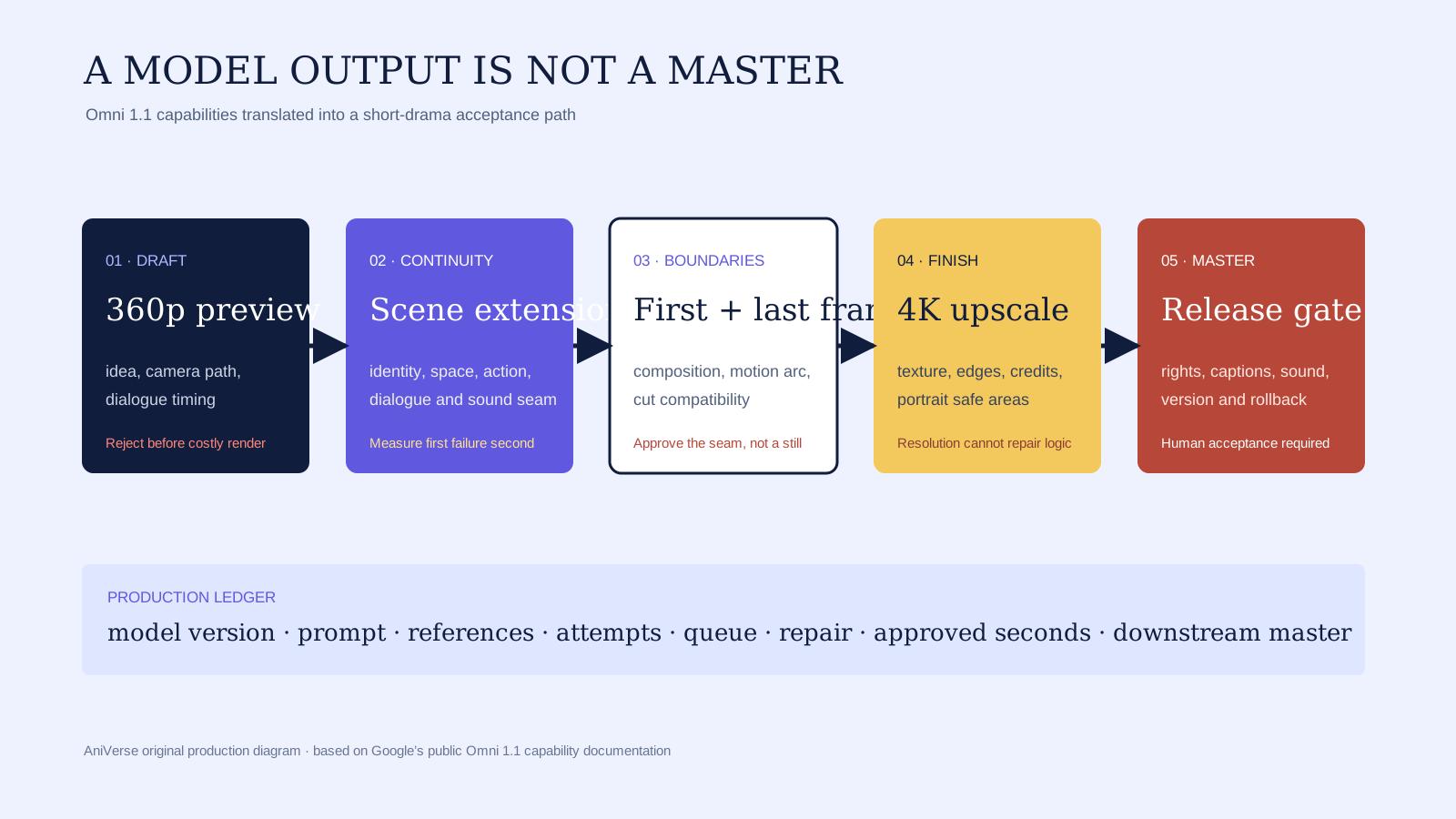
Lock the documented boundary before writing a verdict
Google's documentation establishes the test boundary: up to ten seconds of prior context, ten-second continuation steps, forty seconds cumulative length, first and last frames, 360p previews and 4K upscaling. It also makes the product available through several developer and subscriber surfaces. The first line of a test sheet should preserve access date, surface, model identifier and available parameters because one product name may expose different capabilities across accounts and time.
Official examples teach the interaction but cannot become the project sample. Choose one difficult yet bounded scene: two characters in a fixed location complete twenty to thirty seconds with dialogue, a prop handoff, changing eye lines and a closing action. This exposes identity, space, sound, action and continuity at once and answers a short-drama question more usefully than an atmospheric landscape.
Gate one is cheap rejection, not cheap approval
A 360p preview owns three decisions only: whether composition points in the right direction, whether the action path works and whether dialogue and music timing merit continuation. It does not approve skin, hair, small text, compression edges or final caption safety. Reviewers must distinguish direction approval from shot approval so that a cheaper pass is not mistaken for a quality promise.
Keep at most three previews per direction and record the rejection reason. If motion still fails, return to boundary frames, reference assets or boards instead of drawing indefinitely. The value of preview lies in stopping a bad route early; preserving only the best attempt hides whether the model actually reduced experimentation.
Accept extension at the seam and boundary frames in the middle
Review an extension across the last two seconds of the source, the first two generated seconds and the remaining continuation. At the seam inspect body speed, gaze, ambience, light direction and prop position; later inspect identity, spatial direction and whether the dramatic instruction survives. Forty seconds is a limit, not a production target. If important dialogue or group action becomes unstable at twenty, divide the shot rather than chase the product ceiling.
Boundary-frame testing reverses the problem: the endpoints are supplied and therefore easiest to make correct; the path between them is the evidence. Mark anatomical errors, occlusion, prop distortion, camera acceleration and abrupt lighting frame by frame. A beautiful start and finish cannot rescue an implausible middle.
Passing upscale only starts the mastering problem
A 4K review asks not whether the image is sharper, but whether upscaling introduced edges, skin artifacts, texture errors, text defects or jitter. Once it passes, portrait placement, safe areas, captions, dialogue, loudness, AI disclosure, provenance, territorial rights and compression still remain. Model output and release master need separate version IDs, and a platform revision must never overwrite the original result.
Adoption should be decided by cost per accepted second: include previews, final generations, rejected candidates, waiting, human review, repair and mastering, then divide by seconds actually used. That is the only cost that can be compared with live action, compositing or another model route.