
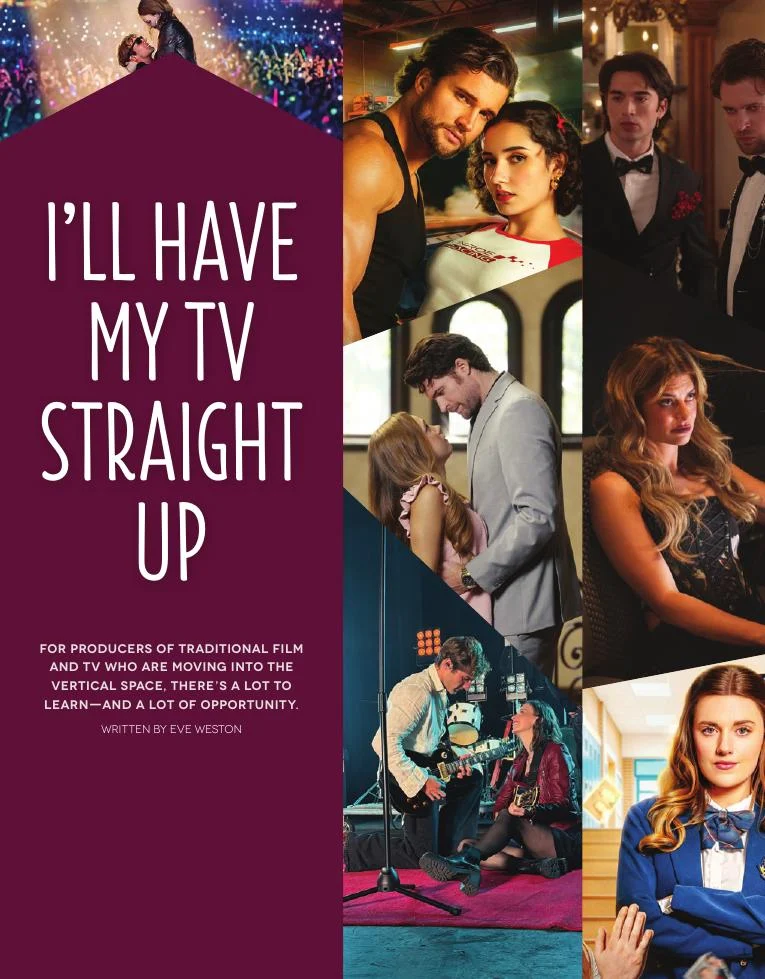
Vertical production is often reduced to a rotated camera and tighter blocking. The Producers Guild of America's June/July 2026 feature, I'll Have My TV Straight Up, instead records how directors, cinematographers and producers redistribute information, labor and budget inside 9:16.
Director Vivian Ip discusses work including ReelShort's Breaking the Ice and Vigloo's Love, Lies, and Alibis. The testimony establishes an emerging craft vocabulary, not a universal cost study or audience verdict. This article therefore reads the interviews beside public title records without treating catalog presence as popularity.
When people fill the frame, wardrobe becomes mobile production design
Ip notes that performers and wardrobe can occupy much of a 9:16 frame, shifting some world-building from background to clothing. The point is not a universal percentage; it is a budget transfer toward elements repeatedly visible in close mobile framing.
Wardrobe should therefore become a story asset ledger, while locations should be tested through doors, mirrors, tables, corridors, light and sound that actors actually use. Less wide scenery does not mean careless design; it means visible, repeatable detail carries more narrative work.
Tell and show is an answer to the viewing environment
The phrase ‘tell and show’ acknowledges unstable mobile viewing rather than endorsing exposition. Dialogue can state a current goal while behavior reveals motive, composition shows power and a prop stores evidence for later payoff.
Teams should test scenes both muted and audio-only. Critical causality should not live in one fragile channel, while captions must preserve names, time and relationships without covering eyes, hands or on-screen devices. Redundancy is designed across modes, not achieved by repeating lines.
Faster lighting and leaner coverage still require choices
Smaller, faster lighting packages do not mean no lighting. Close mobile frames expose skin, eyes, hair edges, background separation and continuity. Professionalism shifts from equipment scale to reproducible character treatment across fast moves.
Lean coverage also needs a spatial relationship, principal performance, counter-reaction and a useful detail or transition. Minimal means every setup has a defined editorial purpose—not that a scene is left without choices in the edit.
Seventy-one episodes should form a pressure curve, not seventy repetitions
ReelShort's public page records 71 episodes for Breaking the Ice and episode summaries, but not aligned viewing or payment evidence. The craft question is how reunion, hidden child, workplace power and family resistance escalate rather than recur unchanged.
A script ledger can track new fact, irreversible choice, relationship temperature and the question left at each ending. Because production groups scenes rather than episodes, performance continuity must also record what each character knows, the previous beat, physical distance and remaining emotional range.
Cost belongs to approved minutes, not episode count
Shoot days and episode count can hide rework. The useful unit is an approved minute that includes rejected takes, waiting, media handling, editing, dubbing, repair, localization, platform QC and post-release correction.
Daily reports should distinguish planned, captured, technically passed, performance passed, pickup and final use, with post-production feeding failure reasons back to production. Sustainable efficiency also requires defined hours, rest, safety, minors, intimacy, handoff and revision scope rather than unpaid labor disguised as speed.
Mobile close-ups magnify performance—and casting mistakes
Faces, hands and breath dominate vertical close-ups. Casting should test quiet listening, concealed information, serial reactions and the same line across relationship stages—not only one confrontational monologue.
Directors need to review at real phone size. Voice rhythm, blocking habits, touch boundaries, wardrobe silhouette and camera distance can distinguish characters and later guide dubbing, subtitles and marketing. There is no single exaggerated ‘vertical acting’ style; there is precise control of readable information.
Craft matures when every department can name its story function
The PGA feature matters because it makes wardrobe, lighting, camera, direction and production choices visible again. Audiences ultimately encounter people, relationships, rhythm and a specific world; a faster pipeline that does not preserve those objects simply manufactures forgettable material faster.
A department story-responsibility sheet can define what writing, direction, camera, lighting, wardrobe, sound, editing and distribution each make legible and how it is accepted. Industry coverage should likewise name practitioners, craft, tradeoffs, evidence and unknowns. A format becomes a medium when its craft can be taught, reviewed and improved.
Sound decides whether a vertical drama lives inside the phone
A phone may play through speakers, one earbud, cheap Bluetooth audio or silence. Dialogue must remain intelligible without turning the work into a podcast, and production sound should prevent dozens of episodes from paying the same noise-repair and ADR cost.
Mix hierarchy, room tone, wild lines, wardrobe-noise tests and same-day ADR notes make speed sustainable. The silent version also needs authored caption timing and coordinated on-screen text rather than an automatic subtitle layer that crowds the frame.
A reusable vertical manual starts with failures, not glamour stills
The reusable knowledge of a production sits in rejected shots: moire after compression, flat corridors, muted causality, inflexible lighting, or a hook that failed to produce continuation. Finished masters alone do not preserve that learning.
A closeout should link best and most expensive shots, planned-to-used ratio, department failure types, audience evidence and changed templates back to script, production and release versions. Over several titles this becomes a versioned company manual, not a slogan that makes every show look the same.
Vertical industrialization does not delete craft; it makes every visible investment carry a clearer story function. Real efficiency is measured in approved minutes, performance continuity, reusable versions and sustainable labor—not slogans built from shoot days and episode counts.