
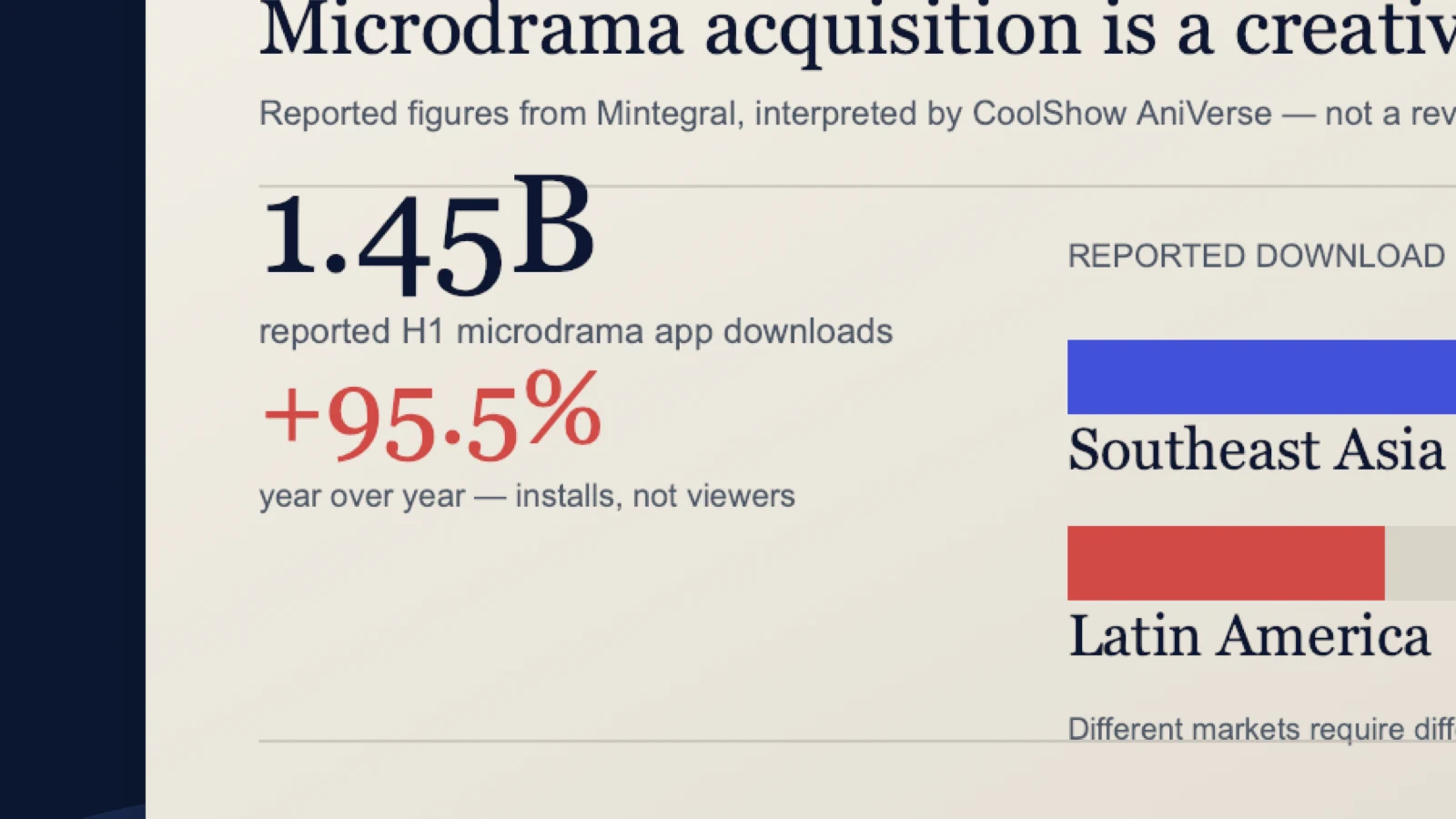
Marketing Dive and Tubefilter reported Mintegral figures of 1.45 billion microdrama app downloads in H1 2026, up 95.5% year over year, including roughly 518 million in Southeast Asia and 355 million in Latin America. They also reported about three million ad creatives across 1,887 apps.
These are advertising-platform observations of downloads and creative activity. They do not establish 1.45 billion unique viewers, opens, viewing, payment, revenue or profit. AniVerse treats them as acquisition-competition evidence, not a retention verdict.
High ad density first describes competition for visibility
Creative density is ads divided by active advertising apps, not the number of ads inside episodes. It shows high-frequency testing of characters, conflicts, languages and payment hooks, turning acquisition creative into a second production line.
Teams need creative hypotheses, audience, territory, version, spend, install, payment and retirement records. A winning asset is effective in a defined window, not a permanent template; volume without learning simply accelerates fatigue and story misrepresentation.
Southeast Asia and Latin America cannot share one operating model
Large download contribution from Southeast Asia and Latin America does not reveal payment capacity, ad value, connectivity, language cost or retention. Each market needs separate acquisition cost, day-seven and day-thirty retention, episode conversion, first payment, refund, localization cost and payback.
Content also varies across family, class, religion, celebrity and platform habits. Regional data should guide the depth of subtitles, dubbing, remakes or originals rather than replace local editorial and user research.
App rank and title rank are different evidence
An app download ranking cannot establish a title popularity ranking. Users acquired by a platform may watch very different catalog items, and title performance needs exposure, starts, completion, unlock, repeat and refund evidence that public market data rarely supplies.
AniVerse therefore preserves platform-native lists with platform, list name, capture date and official link, while labeling editorial recommendations separately. It does not manufacture a global top ten from incompatible catalogs and methods.
A useful funnel runs from creative to payback
Acquisition, content and finance tables need stable IDs linking campaign, creative, promise, title, episode, locale and offer. That reveals whether a click promise was delivered, where viewing stopped, when payment occurred and whether refunds followed.
Payback includes media, store share, localization, support, refunds, production and ongoing creative. Cohorts need territory, genre, retention horizon, attribution window and method version; otherwise ROAS is an easily misused percentage.
Download growth turns supply from availability into renewal
Rapid acquisition creates a continuing slate requirement. More titles do not automatically create durable supply when genres, relationships, hooks and low-quality localizations repeat. Catalogs need distinct acquisition, retention, payment, brand and experiment roles.
Renewal should use title completion, payment depth, repeat, response, sustainable production, local version performance, rights cost and creative runway. App download growth expands the sample but does not make the content decision.
Data providers have position and blind spots
Mintegral observes the mobile advertising and app ecosystem available to its data relationships. That position offers valuable cross-market scale clues while leaving possible blind spots across web payment, alternate stores, television and offline distribution.
AniVerse preserves provider, period, geography, object and definition, and never adds downloads, plays, audience-persons, MAU and payers. Incompatible estimates remain side by side with methodology rather than being forced into one market total.
Six questions every growth story should answer
Every growth story should ask what is counted and deduplicated, which stores, territories, devices and dates are covered, what creates growth, whether viewing and retention move with it, how revenue is defined, and where cost and payback sit. Missing answers do not erase the data, but they must remain visible.
The 1.45 billion figure matters because microdrama has become a significant app-distribution and creative category. It is also a warning: acquisition is moving faster than methodological transparency. Durable operators will explain audience relationships and catalog economics rather than merely accumulate installs.
A weekly operating note can turn growth into management
A useful weekly note follows one cohort through deduplicated installs, retention, episode depth, payment, refunds, channel fees and acquisition cost, preserving territory, currency, attribution window and method version. It then links winning qualified-user creative to the promise actually delivered in the first episodes.
The note also exposes uncertainty, frames next actions as falsifiable questions, and keeps a four-week catalog and risk view. When audience, title, money, method and rights sit in one review, downloads become an operating relationship rather than a headline.
Four data mistakes produce the wrong business action
Common mistakes turn download growth into premature production, territory scale into price assumptions, high-click creative into universal templates, and app rank into title acquisition. The corrective evidence is cohort retention, viewing depth, payment behavior, qualified acquisition and title-level performance.
Each metric should also declare prohibited uses, while monthly source audits preserve links, observation time, units, geography, bilingual parity and revisions. Estimates change; trustworthy infrastructure records the change instead of silently overwriting history.
The reported 1.45 billion downloads and high creative density establish a global acquisition contest, not 1.45 billion viewers, durable watching, revenue or profit. Platforms need stable links from creative promise through install, title viewing, payment, refund and payback; catalog decisions need title-level evidence; reporting must preserve provider scope and method.