
A Google Gemini video-generation update documented in August 2026 with generation, extension, boundary-frame and upscaling controls.
EDITORIAL DOSSIER · Models
Gemini Omni 1.1 Flash
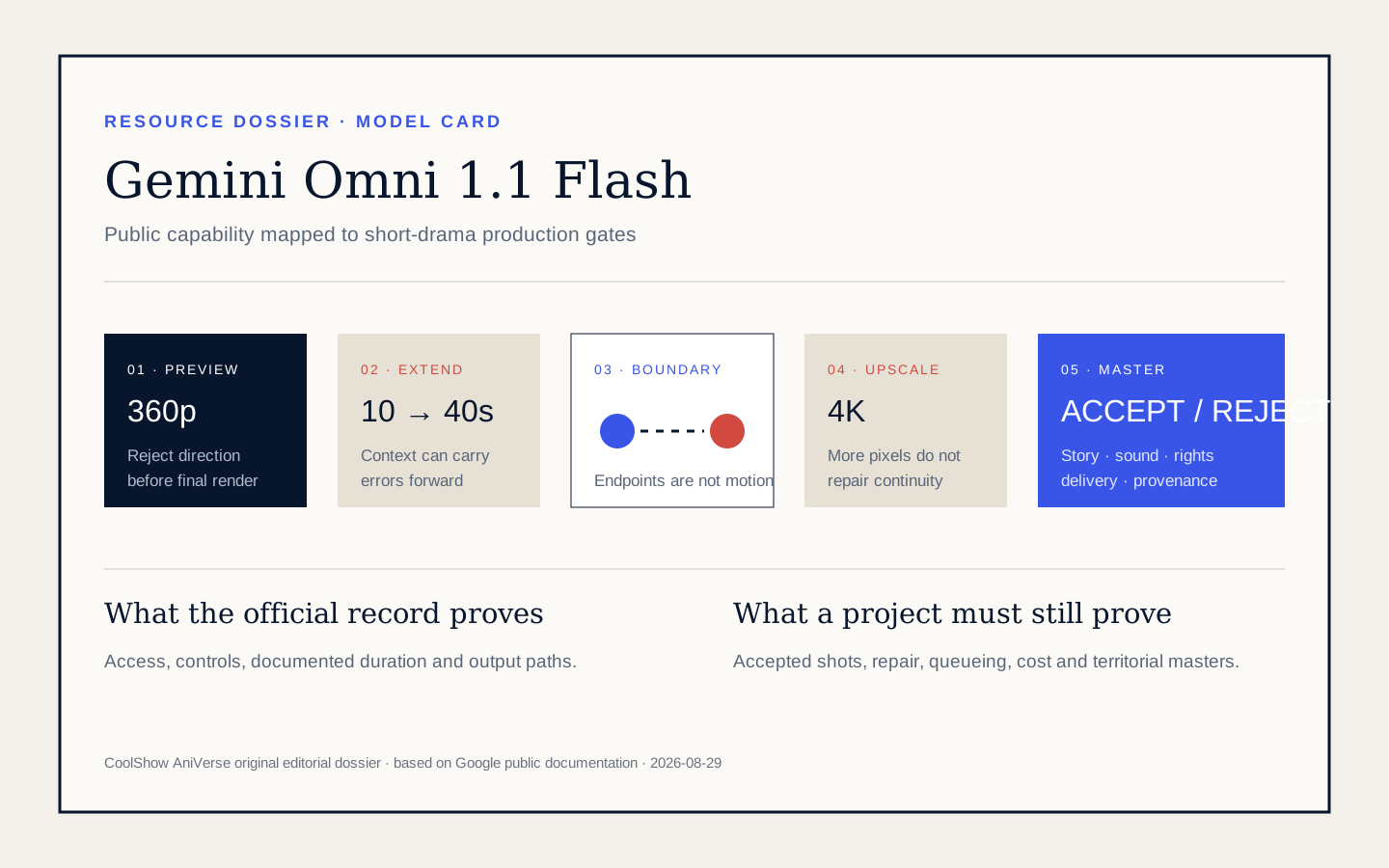
Omni 1.1 Flash belongs in a short-drama shot test because it connects low-resolution preview, scene extension, boundary frames and 4K upscaling. The dossier does not celebrate maximum duration; it identifies the character, action, sound, cost and mastering gates that remain.
- Completeness
- 100%
- Region
- Global
- Evidence
- 2 sources
- Verified
- Aug 29, 2026
60-second briefing
FACT → CONTEXT → BOUNDARYIt separates cheap preview rejection, shot extension and final upscaling instead of rendering every attempt as a high-spec output.
Production, VFX and technical teams testing character-state transitions, continuous action, boundary composition and versioned masters.
Public materials do not provide fixed-sample character drift, dialogue sync, queueing, failure rate or cost per accepted short-drama shot.
ROLE LENS · Production lens
Production
Separate preview, extension, boundary frames, upscaling and mastering into five gates; account by accepted shot rather than generation count.
BASIC RECORD · INDEX ENTRY
This resource is not yet a deep dossier
This page exposes verified identity, sources and existing fields only. It does not fill company analysis, workflows or timelines with generic prose; missing fields are listed below.
- Still missing
- type-specific fields
EDITORIAL ANALYSIS
It changes the shot-cost path, not the quality verdict
A 360p preview lets teams reject wrong composition, movement and narrative direction before committing to generation and upscaling. Boundary frames define character-state endpoints, but action, eye lines, props and space between them still require review.
Extension to forty seconds may reduce some cuts while propagating an early error into later material. Professional adoption records task ID, model version, reference assets, every failure, human repair and final master outcome.
OPERATING GUIDE
From candidate model to production route
Choose three shot classes representing project risk: dialogue and lip sync, character movement with props, and complex transitions between boundary states. Lock reference assets, duration, aspect ratio, sound and acceptance rules before running preview, generation, extension and upscale.
Review does not preserve only the best result. Every failure, retry, human repair, queue time and rejection reason enters the ledger. Expansion depends on cost per accepted shot and master acceptance.
OPERATING GUIDE
Published capability does not replace project testing
Official pages establish access, controls and product claims. They do not prove reliable acceptance for a character, genre, shot language or territorial master. Teams should repeat fixed, rights-cleared assets at least three times and preserve rejected outcomes.
Results must identify test date, account surface, model version, reference assets, prompts, reviewers and failure handling. Showing only the best output would turn the dossier back into a demo reel.
Type-specific profile data
FIELD-LEVEL EVIDENCE- Access
- Gemini API, Google AI Studio and enterprise Agent Platform; Flow access follows official termsVerified · 2026-08-29
- Controls
- Scene extension, first/last frames and preview-before-upscaleVerified · 2026-08-29
- Duration
- Ten-second extensions up to forty seconds cumulatively; not a dependable dramatic-duration promiseVerified · 2026-08-29
- Scene extension
- Reads up to ten seconds of prior context and extends in ten-second increments to forty seconds cumulativelyVerified · 2026-08-29
- Inputs
- Text, first frame, last frame and prior video context; combinations follow current API documentationVerified · 2026-08-29
- License
- Verify Google terms, territory, account and reference-asset rights per useVerified · 2026-08-29
- Limitations
- No published fixed short-drama evidence for character drift, lip sync, failure, queueing or cost per accepted shotVerified · 2026-08-29
- Modalities
- Video generation and extensionVerified · 2026-08-29
- Organization
- "Google"Verified · 2026-08-29
- Outputs
- Generated clips, extensions and upscaled outputVerified · 2026-08-29
- Region
- "Global"Verified · 2026-08-29
- Preview and upscale
- 360p preview and 4K upscaling form two stages and do not establish master acceptanceVerified · 2026-08-29
- Resource type
- "视频模型"Verified · 2026-08-29
- Current version
- Omni 1.1 Flash (public update dated 27 August 2026)Verified · 2026-08-29
- Access
- Gemini API, Google AI Studio and enterprise Agent Platform; Flow subscription access follows official documentation
Industry relationship graph
2 EXPLICIT EDGESGemini Omni 1.1 FlashModels
available in workspaceGoogle FlowVerified · 2026-08-29
maintainsGoogle DeepMindVerified · 2026-08-29
| Relation | Connected resource | Status | Observed |
|---|---|---|---|
| available in workspace | Google Flow | Verified | 2026-08-29 |
| maintains | Google DeepMind | Verified | 2026-08-29 |
Product, capability and profile timeline
VERSIONED EVENTS- Analysis
AniVerse establishes a short-drama acceptance dossier
- Analysis
Google publishes the Omni 1.1 Flash update
In-profile learning path
INPUT → OUTPUT → QUALITY GATE- 01
Build a fixed shot pack
- Input
- Three rights-cleared short-drama shots and target frames
- Output
- A versioned test pack
- Gate
- Every shot has acceptance rules and protected elements
- 02
Run five gates
- Input
- Preview, extension, boundary-frame and upscale jobs
- Output
- Task and review ledger
- Gate
- Failures, retries and human repair are included
- 03
Validate the release master
- Input
- Accepted shots, captions, audio and territorial specs
- Output
- Deliverable master and limitation note
- Gate
- Pixel specification does not replace content and compliance review
Limits, analysis and unknowns
EVIDENCE BOUNDARYKnown limits
- Extension inherits prior context, so early errors may propagate.
- Upscaling cannot repair narrative, lip sync, rights or character continuity.
Editorial analysis
- Preview staging may reduce wasteful high-spec renders, but savings depend on draft-to-final consistency.
Still unknown
- Project acceptance, queue distribution, repair time and cost per accepted shot remain unknown.